Amish … mafia?

Lancaster, PA

Lancaster, PA

The Amish and Reality Television


Is Amish Mafia real? It’s a question I’ve heard buzzing around lately. The Discovery Channel series premiered on December 12th, and it’s caught the attention of millions of viewers. If you click over and read the description of the series, it certainly sounds real enough.

“This is a side of Amish society that exists under the radar, and the Amish church denies the group’s existence. Amish Mafia provides eyewitness accounts of the incidents, misdeeds and wrongdoings within the Amish community …”

There you have it! Eyewitness accounts. It must be real. Maybe. Or maybe not. The Washington Post spoke with Ira Wagler, author of Growing Up Amish in this article. Ira says no. It’s not real. Sam Stoltzfus, of Lancaster, PA, wrote his editor and said “Those characters are not Amish.”

I have published 5 Amish books and have 8 more contracted for the next 3 years. Some of those are romances and some are murder mysteries. Murder? Yes . . . because no community is perfect. They are stories of mystery and grace and forgiveness. While researching, I’ve visited Amish communities in Indiana, Wisconsin, Texas, Ohio, and Pennsylvania. I’ve been to Amish homes, Amish barns, and Amish stores. I’ve eaten dinner with Amish families, Amish bishops, and Amish children. I don’t know all there is to know about the Amish, but I do know that they are what they appear to be–people living a simple life, committed to the Gospel of Christ.

And I can tell you I’ve never seen anyone even remotely resembling Amish Mafia.

Perhaps the simple, plain life we see is too calm, too perfect, almost too boring, if you only look on the surface of things. Maybe that’s why a producer in New York or LA came up with the idea of an organized group of men who “protect and maintain peace and order within the Amish community.” A fictional story line? I think so. Maybe it’s poor reporting, but for some–it’s good entertainment.

Vannetta


Free Recipe Friday!

Author Jerry Eicher and his wife, Tina, have collected their favorite dishes in The Amish Family Cookbook. They had a lot of fun imagining some of the recipes came from beloved characters in Jerry’s novels!

Have you read A Baby for Hannah? Today’s recipe could be what Hannah baked for Jake in this scene…

Jake ate his supper slowly as Hannah watched his face.

“I made pecan pie today,” Hannah said. “Espeically for you.”

He smiled weakly, meeting her eyes…


Happy Baking, Everyone!


Hannah’s Pecan Pie

3 eggs

1/3 cup butter, melted

1 cup light corn syrup

1/2 tsp. salt

2/3 cup sugar

1 cup pecan halves

1 unbaked pie crust

Beat first five ingredients on low speed slightly or with hand beater. Stir in pecan halves. Pour into pie crust. Bake at 375 degrees for 40-50 minutes.


Merry Christmas and Happy New Year to Ebook Fiction Readers!

Hello, AmishReaders!

We want to wish you a Merry Christmas and Happy New Year with a terrific sale on LOTS of great fiction! All the titles listed below are available (for a limited time!) for $2.99/each at your favorite ebook retailer! Happy Reading!

–Your Friends at AmishReader.com


Amish Fiction

A Promise for Miriam by Vannetta Chapman

The Amish Bride by Mindy Starns Clark and Leslie Gould

A Plain and Simple Heart by Lori Copeland and Virginia Smith

My Dearest Naomi by Jerry and Tina Eicher

Living in Haromony by Mary Ellis

To Love and to Cherish by Kelly Irvin

Plain Jayne by Hillary Manton Lodge

A Stranger’s Wish by Gayle Roper


Inspirational Fiction

Westward Hearts by Melody Carlson

Whispers of the Bayou by Mindy Starns Clark

Ransome’s Quest by Kaye Dacus

Song of the Silent Harp by BJ Hoff

The Beach House by Sally John

Jessie by Lori Wick

Pretense by Lori Wick


Amish newspaper reflects faith, love of community

The Budget Newspaper

I love to read The Budget newspaper. For those of you who don’t know, it’s a national publication full of articles written by Amish “scribes” from all across the country. It is national, but yet it feels like a community newspaper, full of the bits and pieces of news that the writers would share in letters to family members. It’s as if they are writing to family.

 The Budget reminds me of the little daily newspaper in my hometown of Abilene, Kansas. When I was growing up, my dad would sit in his easy chair in the living room and peruse the pages, looking to see who died, who had a baby, who got married, who graduated, who got baptized, and who spent the night in the county jail. The Reflector Chronicle told the tale of a small town where everyone knew everyone and wanted to know how they were doing. It’s so different from the news now, which is fast and furious and focused on the negative—so much so that we may begin to think that if it weren’t for bad news, there’d be no news at all.

 The Budget proves that isn’t so. The scribes write of seeds sowed and reaped, fresh eggs for breakfast, canning and sewing frolics, fishing, communion and baptism, school trips, and weddings, and ice cream and bird watching. True, when there’s bad news, the scribes don’t sugar coat it, but they put it in perspective. One scribe reports that a bishop’s wife had brain surgery and never recovered consciousness—not the outcome the family wanted, but the wife “is blissfully happy in the presence of her Lord.”

They sprinkle their stories with proverbs like “If you want to feel rich, just count all the things money can’t buy,” or “Don’t be  like the wheelbarrow which goes no farther than it is pushed.” Do you ever feel like that? I know I do.

On a day like today, I know why we admire the Amish so much. They work hard, they keep their family and their community close, and above all else, they trust in the Lord. The pages of The Budget reflect that faith in every word and every sentence. One couple ended their report with a thought we can all hang on to today and everyday: “We may not know what the future holds, but we can trust the One who holds the future.”

Amen!

A Special Offer for Our Ebook Fiction Readers!

Starting today, December 14, 2012, we have a great deal on some great reads! You’ll find all the titles listed below for $2.99/each — available wherever ebooks are sold!

This offer won’t last forever…it ends on Monday, December 17, 2012. So, check out your favorite ebook store today. And Happy Reading!

–Your Friends at AmishReader.com

Amish Fiction

Following Your Heart by Jerry Eicher

An Amish Family Reunion by Mary Ellis

Other Inspirational Fiction

Echoes of Titanic by John and Mindy Clark

When Love Comes My Way by Lori Copeland

When All My Dreams Come True by Janelle Mowery

Every Storm by Lori Wick

Wings of the Morning by Lori Wick


Wringer Wash Machines Reflect Amish Work Ethic

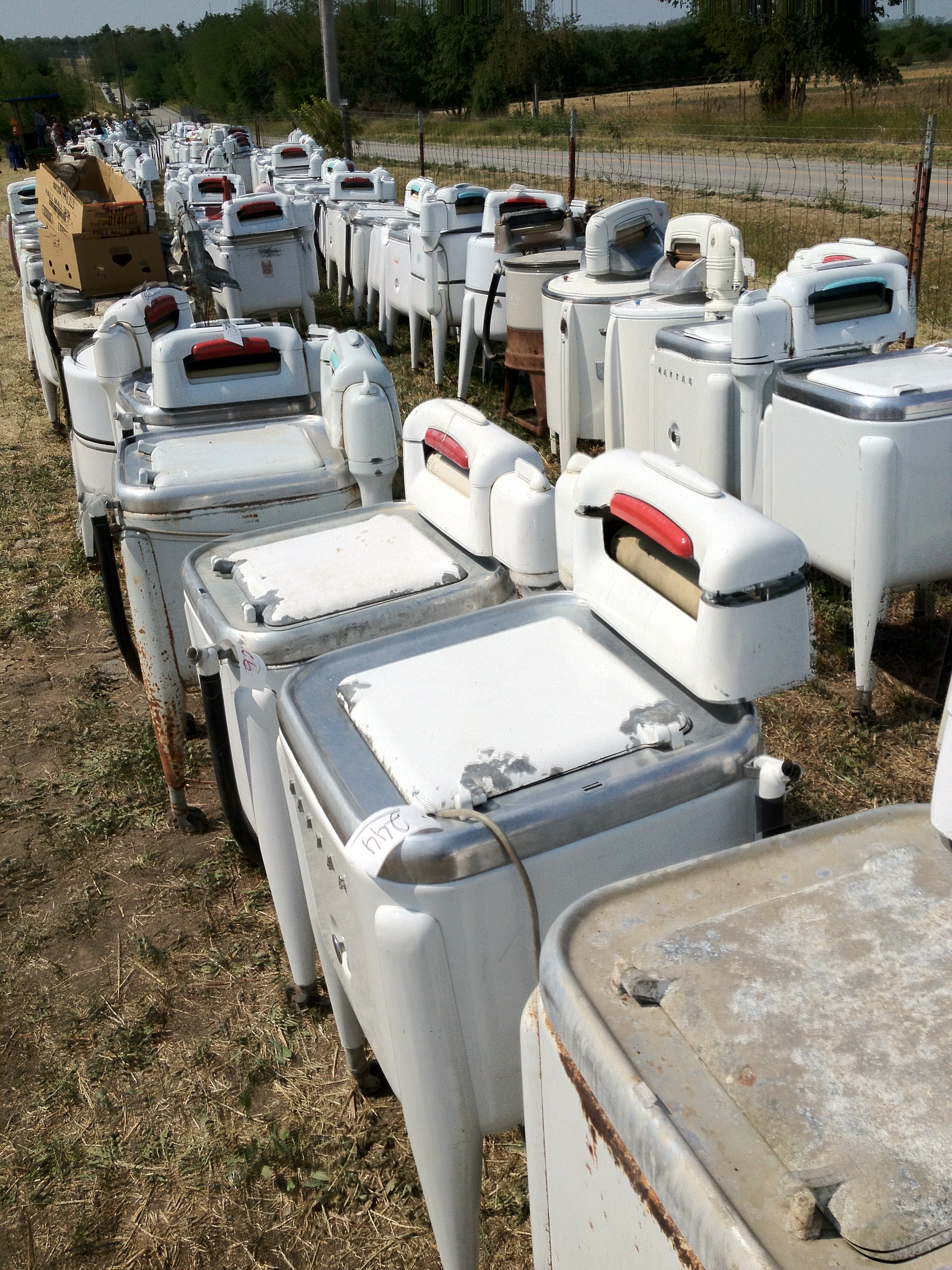
Last summer my husband and I attended an Amish school fund-raiser auction in Jamesport, Missouri. The auction was a beehive of activity of all kinds. Three auctioneers yelling at the same time. People from all over the state wandering through rows and rows of farm equipment, furniture, and dishes and pots and pans. The items that caught my attention immediately were the wringer wash machines–hundreds of them. They were mostly used, but some looked brand new. I knew many Amish families use wringer wash machines that have been retrofitted to run on propane, but I’d not really given any thought to what that means. It makes the job of doing laundry for families that typically have seven or eight or more children easier because they don’t have to wash them by hand. However, it’s certainly not easier by English (non-Amish) standards.

 If you’ve ever done laundry with a wringer wash machine, you know it’s not easy, compared to using a modern day wash machine with a spin cycle. I know because as a youngster it was my job to do laundry for our family of seven. We had a wringer wash machine and no dryer. So a typical laundry day involved gathering the laundry on the covered back porch, sorting it, running a hose to the wash machine to fill it, and then filling two large sinks with cold water. I ran the clothes, piece by piece, through the wringer into the rinse water in the first sink, ran them through the wringer again into the second tub for another rinse, and then wrung them out a third time into a basket. From there it was on to the backyard to hang them on the clothesline.

 As you can imagine, this was a long, tedious, job. I never thought much about it, though. We’d always done it that way. The time a huge, black, hairy spider leaped from the clothes basket into the sudsy water, riding the waves into I wacked him out with a newspaper—that stands out in my mind. The clean smell of the soap and bleach still lingers in my memory and the pleasant, steady, swish, swish of the water being agitated in the machine—those memories still surface when I smell clothes soap even now. As I write my Amish romances, I imagine the young Plain women doing the same thing. Inhaling the scent of clean and knowing they’re taking good care of their families.

 The decision to use a wringer wash machine by some Amish communities would not be a decision made lightly. They don’t shy away from hard work and they’re thoughtful about embracing modern day conveniences that might lead them astray from their commitment to keep themselves apart from the world. They don’t have to do it the easy way. They see a value in being tired at the end of the day because they’ve worked hard. Their way of life certainly helps me keep in perspective the concept of hard work. It’s good for the soul and the body.

A long row of wringer wash machines at the Jamesport Amish school fund-raiser.

A Little Amish Humor

“So what would you do if someone gave you two cows?” the skeptic asked of the three men.

“I’d give both of mine to charity, and expect my reward in heaven,” the Quaker said.

“I’d give my two cows to the colony, and they’d keep my family in milk,” the Hutterite said.

“I think I’d keep one of my cows, and trade the other for a bull,” the Amish man said.

–Today’s laugh is from The Amish Family Cookbook by Jerry and Tina Eicher

Home cooking for cooler days

SWEET AND SOUR RED CABBAGE

Old German Recipe by Rosanna Coblentz

¼ cup butter

4 med apples, peeled and sliced

½ red onion, chopped

1 head red cabbage, finely shredded

1 cup red wine (opt.)

4 whole cloves

1/3 c brown sugar

2 bay leaves

¼ cup vinegar

¼ cup butter

Juice of ½ lemon

Sliced or cubed cooked pork roast (opt.)

Melt butter in 4 quart Dutch oven. Add apples and onion sauté slightly.  Add cabbage, red wine, cloves, sugar and bay leaves.  Simmer covered for about 1 hour, then add the remaining ingredients.  Heat to melt the butter and serve immediately.  Makes 6 servings. Note: For a hearty main dish, add sliced or cubed cooked pork roast, as much as desired, during the last hour.

Every good rule is eventually broken

Readers and writers of Amish fiction have discovered certain “rules” about the Amish–lifestyle choices that almost never vary from one Old Order district to the next, from one state to another. But the more I research this fascinating culture, the more I arrive at the conclusion every good rule is eventually…broken. During last summer’s trip to central Maine in preparation to write Living in Harmony, I found Unity, Maine challenged 3 of my long-held beliefs…two regarding the Amish, one involving my brief, past history as a 6th grade science teacher. First of all, unlike most Old Order districts, Unity Amish had built a meeting house to use for worship and social events, instead of holding services in each other’s homes. Secondly, unlike most Amish who avoid government paperwork, these farmers are gaining organic certification for their produce. And my science lesson? I’d learned every lake has a fresh-water intake flowing into it. Here’s a couple photos of Lake Unity, which has no freshwater source, other than rainwater. Glacially-formed, it only has an outtake for periods of heavy rain to prevent flooding of nearby homes. I hope you’ll look for Living in Harmony about the Amish of central Maine.

Whoopie Pie History & Recipe

Whoopie pies are considered a New England phenomenon and a Pennsylvania Amish tradition. Whoopie Pies have also been known as a “gobs.” in Western Pennsylvania (see Gob History below).

They are one of Maine’s best known and most loved comfort foods. Mainers will even claim that they were weaned on whoopie pies. In Maine, these treats are more like a cake than a pie or a cookie, as they are very generously sized (about hamburger size). they’re so hug that you’ll want to share one with a friend. A big glass of milk is almost mandatory when eating a whoopie pie.

Photos from Labadies Bakery

Whoopie Pie

Whoopie Pie

A whoopie pie is like a sandwich, but made with two soft cookies with a fluffy white filling. Traditional whoopies pies are made with vegetable shortening, not butter. The original and most commonly made whoopie pie is chocolate. but cooks like to experiment, and today pumpkin whoopie pies are a favorite seasonal variation.

The recipe for whoopie pies has its origins with the Amish, and in Lancaster county, Pennsylvania, it is not uncommon to find roadside farm stands offering these desserts. Amish cooking is about old recipes that have fed families for generations, with no trendy or cross-cultural fusions or mixtures. These cake-like whoopie pies were considered a special treat because they were originally made from leftover batter. According to Amish legend, when children would find these treats in their lunch bags, they would shout “Whoopie!”

Gob History:

It seems that only in western Pennsylvania, mainly the Johnstown area, they are know as “gobs.” The bakers at the now closed Harris & Boyar Bakery in Morrellville, PA, claimed to have invented the treat sometime in the 1920s. Probably they adapted what was already a regional favorite inspired by the cream-filled whoopie pies of Pennsylvania Dutch country, in the eastern part of the state.

According to an article in the Johnstown Tribune-Democrat newspaper, Johnstown’s Gob – A mealtime tradition, March 12, 2009:

Susan Kalcik, a folklorist and archivist with the Southwestern Pennsylvania Heritage Preservation Commission in Johnstown, said her research shows that the Gob’s origin can be traced back to medieval Germany. “They were making a cake-like pastry with a filling. It probably was brought to America by various German groups like the Amish or German Brethren.”

But Kalcik said the Gob is not a Johnstown invention. The Amish in Lancaster make them and she’s seen them as far south as Virginia. “They don’t call them Gobs, they’re called Whoopee Pies, ” she said. “I’ve also found Whoopee Pies in New England and as far away as Hawaii.”

Kalcik believes that the Gob became popular because it was easy to carry in a lunch bucket. “Men went into the coal mines or steel mills and the little cake with the icing on the inside instead of on the outside served their purpose,” she said. “I’m convinced that the name Gob is related to the coal mines. Lumps of coal refuse were called gob piles. These working people adapted the name to the dessert.”

But technically, not just anyone can use the name “Gob” for the familiar icing filled treats. The name-along with all the rights to market “Gobs”- belongs to Tim Cost, owner of Dutch Maid Bakery. Cost, who bought the rights from Harris & Boyar Bakery in Morrellville, said he’s always had a passion for the cake.

At the Hershey Farm and Inn in Strasburg, PA, an annual Whoopie Festival is held featuring a whoopie pie eating contest and the coronation of the Whoopie Pie Queen.

In 2011, The Maine State Legislature considered making the Whoopie Pie the official state’s dessert.

Amish Whoopie Pie Recipe

1/2 cup solid vegetable shortening
1 cup firmly-packed brown sugar
1 egg
1/4 cup unsweetened cocoa
2 cups all-purpose flour
1 teaspoon baking powder

1 teaspoon baking soda
1 teaspoon salt
1 teaspoon pure vanilla extract
1 cup milk
Whoopie Pie Filling (see recipe below)

Preheat oven to 350 degrees F. Lightly grease baking sheets.

In a large bowl, cream together shortening, sugar, and egg. In another bowl, combine cocoa, flour, baking powder, baking soda, and salt.

In a small bowl, stir the vanilla extract into the milk. Add the dry ingredients to the shortening mixture, alternating with the milk mixture; beating until smooth.

Drop batter by the 1/4 cup (to make 18 cakes) onto prepared baking sheets. With the back of a spoon spread batter into 4-inch circles, leaving approximately 2 inches between each cake.

Bake 15 minutes or until they are firm to the touch. Remove from oven and let cool completely on a wire rack.

Make Whoopie Pie Filling. When the cakes are completely cool, spread the flat side (bottom) of one chocolate cake with a generous amount of filling. Top with another cake, pressing down gently to distribute the filling evenly. Repeat with all cookies to make 9 pies. Let finished whoopie pies completely cool before wrapping.

Wrap whoopie pies individually in plastic wrap, or place them in a single layer on a platter (do not stack them, as they tend to stick).

To freeze, wrap each whoopie pie in plastic wrap. Loosely pack them in a plastic freezer container and cover. To serve, defrost the wrapped whoopie pies in the refrigerator.

Makes 9 large whoopie pies.

Whoopie Pie Filling:
For this recipe, you are basically making a homemade Marshmallow Fluff/Creme.

2 Tbs. milk
2 cups light corn syrup
1/2 teaspoon salt
2 cups sifted powdered (confectioner’s) sugar
1 tablespoon pure vanilla extract

mixing the marshmallow fluff In large bowl of an electric mixer, add milk, corn syrup, and salt. Using your electric mixer on high speed, mix for approximately 5 minutes.

On low speed, add powdered sugar and mix until well blended. Add vanilla extract just until well blended.

Your homemade marshmallow fluff/cream is now ready to use on your Whoopie Pies or other recipes. Use immediately, or refrigerate in a covered container for up to 2 weeks.

Makes a large quantity.

 (Excerpts taken from http://whatscookingamerica.net/History/WhoopiePieHistory.htm)