what our Amish friends fear

In my research on another subject a writer called the Amish technophobes and I paused to consider this. The word was used derogatorily and, as a writer of Amish fiction, I felt a bit defensive. A technophobe is someone with an irrational fear of technology.

Possibly the writer who flung out this remark didn’t know the Amish had used Alexander Graham Bell’s invention for a decade before dissing it because it was being used as a means of talking about others behind their backs. He likely also didn’t know that many Amish communities keep a phone booth on site in case of emergencies. (The school teacher who alerted the police to the Nickel Mines shootings used such a phone.)

I doubt he was aware that the Amish use modern medical facilities, surgeries, and medicines to care for their sick when necessary. Nor did he stop to consider that, in their time, horses and buggies and well-made wheels were the modern technology of the day. Nor had he investigated and discovered that the Amish will fly on planes, take trains, and sit as passengers in cars and trucks. They aren’t permitted to own or pilot planes. Or own and drive cars. But they make use of them.

This involvement with modern technologies of the past and present hardly makes them technophobes.

But unquestionably the Amish have a healthy fear of modern technology. They are afraid it may destroy their families and churches and communities. Not because all technology is bad – as I’ve mentioned, they use modern pharmaceuticals and treatments. Simply because all technology is a two-edged sword.

One man uses the internet to look up Bible verses or even research Amish beliefs. Another uses it for the purpose of sexual trafficking. Nuclear energy can light up cities or blow up cities. Smart phones can help people communicate or help isolate them from others nearby they are too preoccupied to speak with face-to-face. If there are cyber blessings there is also cyber bullying. Cars take people to family and friends and on Christian missions. They also pollute the air of our large cities and make it almost impossible for certain people to go outdoors and get a breath of air.

So perhaps the correct terms to use to describe our Amish friends when it comes to modern technology are aware or cautious. As in techno aware or techno cautious. Or techno restrained. They are not knee-jerk afraid of technology nor are they against all technology. However they are very much aware of the harm technology can do and so are cautious of implementing all technologies that show up each year into their communities and homes without discussion and debate. Most of the rest of us just grab all the modern technologies that show up without a second’s thought.

It is the Amish who are techno wise. They reject much but they accept some.

It is a practice many of us could benefit from. Not every device that shows up on the shelves at Wal-Mart is a blessing or enhancement to the Christian lifestyle.

Or any human’s lifestyle.

Where Amish women go to give birth

Misinformation abounds regarding where Old Order Amish women can give birth. In Holmes and Wayne Counties in Ohio, where most of my stories are set, Amish women decide for themselves where to deliver their babies. Some choose the local hospital and will be attended by physicians and nurses. (Always recommended wherever a difficult delivery is anticipated) Some women choose to have their children at home, attended by an Amish midwife. Many women select one of the modern birthing centers springing up in areas of high Amish population. At these birthing centers, expectant moms are attended by licensed midwives/registered nurses (usually either English or Mennonite) and Amish midwives working together. These are family-friendly establishments in terms of husbands and older children. Women paid a flat fee, usually stay three days, and can opt for the underwater birthing tub. I will post some photos of the Birthing Center near Baltic, Ohio—an impressive, state-of-the-art facility. In An Amish Family Reunion, my fictional mom-to-be, Leah, chooses this center where she can relax and enjoy the best of both worlds.

History versus Contemporary

It was an interesting project to tackle: how to portray Amish people in the late 1800’s. I mean, at that time nobody had cars or telephones or any of today’s technology that sets today’s Amish believers apart from the rest of society. Everybody rode in wagons and buggies. Everyone dressed in floor-length dresses. So how were the Amish different from everyone else in that time period? It really was a challenge, and especially for a writer who had never explored the time period of the late 1800’s before.

In the end, Lori Copeland and I decided to approach the story of The Heart’s Frontier as we would any other story – from the perspective of the viewpoint characters.

I admit it took quite a bit of research to discover how Emma Switzer, Amish woman in 1881, would view her contemporary world and how it differed from her non-Amish contemporaries. It’s so different from anything we encounter today! But in the end, Emma and her family were such intriguing characters, and their beliefs were so strong, that the story of The Heart’s Frontier pretty much unfolded naturally. The Amish lifestyle hasn’t changed much since the late 1800’s, but the English lifestyle had undergone several dramatic changes. Today the difference are extremely noticeable. Back then…well, not so much. But there were some very important differences, and I hope we’ve captured the essence of those differences in The Heart’s Frontier.

Free Recipe Friday!

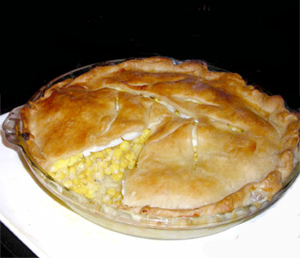
Amish Corn Pie

1 pastry for a double-crust pie
3 cups fresh corn
1 1/2 cup raw potatoes, diced
3 hard boiled eggs, diced
salt and pepper to taste
2 tablespoons flour
milk

Line a casserole or deep pie pan with pastry. Combine corn, potatoes and eggs and pour into pastry lined container. Add salt and pepper. Sprinkle with flour. Add enough milk to cover the vegetables.

Cover with top pastry. Pinch edged together to seal. Bake at 425 degrees for 30-40 minutes, until crust is browned and milk is bubbly throughout.


Enjoy!

The “Ordnung”

Passed along through an oral tradition, the Ordnung by necessity changes and evolves with every new issue that arises and every new technology that presents itself for consideration.  When deciding whether something should be allowed, church leaders focus on key questions like these:


  • Will this force us to be more connected to the outside world?
  • Will this create division in our families?
  • Will this take us too far from home?

For example, members of some Old Order communities do not have bicycles.  After all, if one has a bicycle, he or she may take too much time away from home and family or venture into the outside world too fully.  Thus, with an eye toward the what-ifs of the situation, a decision is made for the district and becomes a part of its Ordnung.

(Taken from “A Pocket Guide to Amish Life” by Mindy Starns Clark)


Proverbs – Lead Me Not Into Temptation

Continuing my discussion of the proverbs and sayings Amish parents use to raise their children, I’d like to share one I ran across during my research for The Heart’s Frontier (Co-authored with Lori Copeland, and available NOW!) In the course of the story the main Amish character, Emma Switzer, comes upon a very tempting sight – cowboy hunk Luke Carson stripped to the waist in a stream attempting to save some waterlogged cattle. Guilt smites Emma as she looks on the sight of Luke’s bare chest, and …

Maummi’s saying repeated in her mind like a mantra. Keep your eyes cast down until the Lord raises them. She knew for a fact that the Lord would not approve of her staring at Luke’s half-clad body, so she kept her back turned, standing in front of Maummi. Lord, lead me not into temptation.

I got a huge kick out of that scene. The picture of Emma standing on the shore of a wide river, trying hard to keep her back turned to the sight of Luke waist-deep in the water. Oh, how hard it is at times to keep yourself from temptation. Emma’s grandmother would be proud, though. Her proverb gave Emma strength!

All humor aside, I do think that proverbs, scriptures and often-repeated prayers come to our aid at appropriate times. That’s one reason it’s important to memorize scripture. I can sometimes hear my grandmother’s voice reciting a well-known Bible verse, just as Emma hears her Maummi’s voice. I hope I can pass on a legacy like that to my grandchildren.

Do you have proverbs or verses that come to mind at just the right time? I’d love to hear about them!

Fish?!? But I don’t LIKE fish…

Georgia here (author of The Homestyle Amish Kitchen Cookbook). I’m slowly but surely moving into the twenty-first century. First it was an iPhone; then I started posting to Facebook; and just this weekend I bumbled my way through setting up a blog. (You can find it at: www.georgiaplainandsimple.blogspot.com.)

This from a gal who, even as a child, was considered to have been born a hundred years too late! Wonders of the world never cease.

This past weekend someone asked me for an easy fish recipe…and maybe one that a person who’s not overly fond of fish would enjoy. So here it is:

Use boneless fish fillets; I usually use tilapia, halibut, or salmon. I then mix together mayonnaise and seasonings…and this is where the fun really starts, because you can easily change tastes. My favorite is green curry paste. I buy it in a small jar at my local grocery store (shouldn’t be hard to find). I don’t add anything else–just the mayo and curry paste. Other times I use Cajun seasoning, or simply fresh grated Parmesan and a bit of minced garlic. The thing is, you can use anything that sounds good to you.

Anyway, once I’ve figured out what “flavor” I want, I pat both sides of the fish with the mayo mixture and place the fillets in a glass baking dish. I bake the fish at 350° until the fish is done…about 20 minutes…but of course the baking time will depend on what fish you’re using and how thick it is, etc. I’ve also been known to bake the fish at 375° when I’m in a hurry, which, alas!, is more often than I care to admit. I just watch things closely so I don’t burn the mayonnaise coating.

That’s it! It takes longer to type up the directions than it does to get the fish in the oven.

Well, I’ll sign off for now. Hope you all have a wonderful week!

Blessings,

Georgia

“The Wings of Morning” GIVEAWAY

With the launch of Murray Pura’s “The Wings of Morning,” let’s give some copies away today!  To enter once, LIKE us on our facebook page.  To enter twice, have a friend of yours LIKE us (they will be entered to win as well). Be sure to post your friend’s name so we can give you the “LIKE” credit.  5 copies of Murray’s new book will be given away.  Ready, set, GO!   Watch the book trailer HERE


When does a daughter become an adult?

I love to delve into the many themes that arise from a complex mother/daughter relationship. In An Amish Family Reunion I deal with the evolving power struggle beteen Julia (the mom) and her adult daughter, Emma. We met Emma in Never Far from Home as a rebellious teenager. Now she’s grown up with a happy marriage and two sons. But both her mother and her mother-in-law insist on making choices for her, much to her dismay. I think back to the relationship I had with my own mom. Here I was…married, teaching school, and handling the resposbilities of my first home, yet my mom would still call to ask: did you lock your doors, remember to take your vitamins, set the alarm clock for work?? Much of that is simple protective love, but she also tried hard to talk us out of vacationing abroad (could catch a dreaded disease) buying a house in the country (too far from the nearest hospital) and adopting a dog from the pound (could have fleas). I never became an adult in my mom’s eyes. Readers–drop me a line! Have any of you reached “adult status” with your mothers?

The Power of Proverbs

One thing I admire about the Amish approach to parenting is the use of proverbs and sayings and scripture verses to instruct the next generation. For my upcoming book, The Heart’s Frontier (co-authored with Lori Copeland, and available in March 2012), I had a terrific time looking at some of those proverbs, and describing how they could be put to use in the life of the main Amish heroine, Emma Switzer. No matter what situation Emma finds herself in, one of her grandmother’s often-repeated proverbs leaps to mind.

For instance, when Emma first encounters the Englisch cowboy Luke Carson, her grandmother lectures, “Remember your instruction, girl. Keep your eyes cast down until the Lord raises them. Then you will see only what He wants you to see.” Oh, how she tries to obey that instruction! Or once, when forced to wait for her papa to make a critical decision, Hard it is to wait on the Lord, but worse to wish you had. How often has that been true in my life.

I think Amish parents are onto something with their proverb-quoting. How often has a memorized scripture verse come to your mind at just the right time? If parents can help to instill those deeply-learned lessons that will arise at just the right time, what a wonderful legacy to leave our children with. Words are powerful, and when used to instruct and train, they can have an impact on an entire generation.